
Is Your Strata’s Contingency Reserve Fund Ready for What’s Next?

Low strata fees can look attractive until the roof needs replacing, the elevator reaches the end of its useful life, or an unexpected building repair cannot be postponed.
That is where the Contingency Reserve Fund, commonly called the CRF, becomes essential.
A properly funded CRF helps a strata corporation prepare for major expenses, protect the condition of its property and reduce the financial shock that can come with sudden special levies. However, building a healthy reserve takes more than depositing the minimum required amount each year. It requires realistic planning, accurate financial information and a clear understanding of the property’s long-term needs.
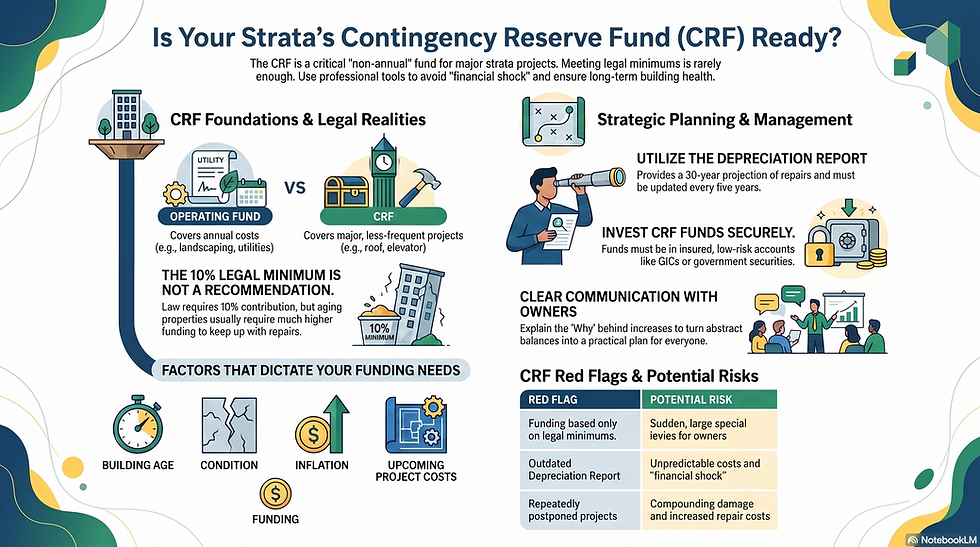
What Is the Contingency Reserve Fund?
Every strata corporation in British Columbia must maintain two primary funds:
An operating fund for expenses that occur annually or more frequently
A Contingency Reserve Fund for common expenses that occur less often than once a year or do not usually occur
CRF expenses may include major projects such as replacing a roof, upgrading an elevator, repaving a roadway, renewing exterior building components or replacing major mechanical systems. The CRF must be accounted for separately from the strata corporation’s other funds. The CRF is sometimes described as an emergency fund, that description does not tell the whole story. Many expenses paid from the CRF are predictable. The exact timing may change, but every roof, boiler, window system and paved surface has a limited useful life. The real purpose of the CRF is to help the strata corporation prepare for those costs before they become urgent.
The Legal Minimum Is Not Necessarily the Right Funding Level
Under the current Strata Property Regulation, a strata corporation’s annual contribution to the CRF must generally be at least 10% of the operating fund contributions. This requirement is a legal minimum, not a recommendation that will necessarily meet the needs of every property. A strata corporation should consider upcoming projects, and projects identified in the Depreciation Report when determining how much to contribute to the CRF.
Consider two strata corporations with similar annual operating budgets. One may have recently replaced its roof, plumbing and elevators. The other may have several major components approaching the end of their useful lives. Contributing the same percentage to the CRF would not necessarily produce an equally responsible funding plan for both properties.
The appropriate contribution depends on factors such as:
The age and condition of the property
Upcoming repair and replacement projects
Current construction costs
Inflation assumptions
The existing CRF balance
Previously approved but unpaid expenditures
The funding approach selected by the owners
A healthy CRF should be based on the property’s actual needs, not simply the lowest contribution permitted by law.
Use the Depreciation Report as a Financial Planning Tool
A depreciation report is one of the most valuable long-term planning tools available to a strata corporation.
For strata corporations with five or more strata lots, a new depreciation report must generally be obtained at least once every five years. Reports obtained on or after July 1, 2025, must be prepared by a qualified person from one of the designated professional groups identified in the Strata Property Regulation. A Depreciation Report includes more than a list of building components. It provides a 30-year projection of anticipated maintenance, repair and projected replacement costs. It must also include the current CRF balance, relevant assumptions such as inflation and interest rates, and at least three cash-flow funding models. Funding models may include different combinations of:
Annual CRF contributions
Withdrawals from the CRF
Special levies
Borrowing
The depreciation report does not make financial decisions for the strata corporation. Instead, it gives owners and council the information needed to make those decisions more responsibly.
A report that is received, filed away and rarely discussed offers limited value. Council should refer to it during the annual budgeting process, compare its projections with current financial results and adjust the funding plan when conditions change.
Balance Present Affordability With Future Responsibility
Strata councils often face pressure to keep strata fees as low as possible. That is understandable. Owners have household budgets, mortgage payments and other rising costs.
However, artificially low strata fees can create a misleading picture of affordability.
Reducing CRF contributions may provide short-term relief, but it does not eliminate the eventual cost of replacing common property. It simply pushes more of that cost into the future, potentially leaving owners with a large special levy when the work can no longer be postponed.
At the same time, increasing contributions without a clear explanation can create frustration and resistance.
The goal should not be to collect the highest possible strata fees. It should be to establish a reasonable and defensible funding plan based on the depreciation report, the strata corporation’s finances and the timing of anticipated projects.
Gradual, consistent contributions are often easier for owners to manage than sudden demands for substantial amounts.
Are Special Levies Always a Sign of Poor Planning?
Not necessarily.
In British Columbia, the correct term is Special Levy. A special levy can be a legitimate part of a strata corporation’s long-term funding strategy, and depreciation-report funding models may expressly include future special levies.
For example, owners may decide to maintain moderate annual CRF contributions while approving a planned special levy for a major project expected several years later. In some circumstances, that may be the funding approach the owners consider most practical.
The concern arises when a strata corporation depends on repeated, unexpected special levies because known expenses were ignored, contributions remained unrealistically low or financial planning was continually deferred.
Good planning may not eliminate every special levy. It should, however, reduce financial surprises and give owners more time to prepare.
Review More Than the Bank Balance
A large CRF balance does not automatically mean the fund is adequate.
Council should compare the available balance with the work the fund is expected to cover. A strata corporation may appear to have a substantial reserve while also facing several costly projects within the next few years.
When reviewing the CRF, council should consider:
The current bank and investment balances
Expenditures that owners have already approved
The projected timing of major projects
Updated cost estimates and available quotes
The annual contribution required under the selected funding model
Whether sufficient funds will remain available after planned work is completed
Whether funds are accessible when upcoming projects require payment
Looking only at the total balance, without considering future obligations, can create a false sense of security.
Invest CRF Money Carefully
CRF funds do not necessarily have to remain in a non-interest-bearing account. However, a strata corporation cannot invest the money in anything it chooses.
The Strata Property Act requires CRF money to be invested in insured accounts with eligible savings institutions or in investments permitted by the Strata Property Regulation. Permitted options include certain term deposits, guaranteed investment certificates, government securities and qualifying fixed-income investments. Interest and other income earned on CRF money become part of the fund. Also, consider the ease of access to the funds, a slightly higher return may not benefit the strata corporation if the money is locked-in when it is needed for an upcoming project.
Before investing CRF funds, council should confirm that:
The investment is legally permitted
Deposit-insurance limits have been considered
Maturity dates align with the expected project schedule
The decision and supporting information are properly documented
Appropriate professional advice has been obtained where needed
The objective is not to pursue aggressive returns. It is to protect the strata corporation’s money while earning a reasonable return within the permitted framework.
Help Owners Understand the Plan
Owners are more likely to support responsible CRF contributions when they understand what the money is for. Rather than presenting an increase as another unexplained cost, council can show owners:
Which building components will eventually require work
When that work is expected
What it may cost
How much is currently available
What could happen if contributions remain unchanged
How the proposed budget fits into the long-term funding plan
Clear communication turns the CRF from an abstract bank balance into a practical plan for protecting the property. It also allows owners to participate in funding decisions with better information.
Signs Your Strata’s CRF May Need Attention
A closer review may be worthwhile when:
Contributions are based only on the legal minimum
The depreciation report is outdated or has not been incorporated into the budget
Major projects are repeatedly postponed without a funding plan
The CRF balance appears healthy, but several expensive projects are approaching
Council is unsure which approved expenses have already been committed
Investments do not align with upcoming cash requirements
Owners do not understand why contributions are increasing
Special levies regularly come as a surprise
These signs do not necessarily mean the strata corporation is in financial difficulty. They do suggest that its funding plan, records or communication may need improvement.
Stronger Reserves Begin With Better Information
A well-managed Contingency Reserve Fund helps a strata corporation move from reacting to problems to preparing for them.
The strongest funding plans combine:
A current depreciation report
Realistic annual contributions
Accurate and timely financial reporting
Thoughtful investment and cash-flow planning
Regular review of future projects
Clear communication with owners
No funding strategy can predict every emergency or eliminate every special levy. A responsible strategy can, however, reduce uncertainty, distribute costs more fairly over time and give owners greater confidence in the financial management of their community.
Not Legal Advice - The material provided on this website is for general information purposes only. It is not intended to provide legal advice or opinions of any kind and may not be used for professional or commercial purposes. No one should act, or refrain from acting, based solely upon the materials provided on this website, any hypertext links, or other general information without first seeking appropriate legal or other professional advice. These materials may have no evidentiary value and should be checked against official sources before they are used for professional or commercial purposes. Your use of these materials is at your own risk.


Comments